From Japan Focus
Abstract: Although Hong Kong historically has a weak trade union culture, in mid-2020 activists in the movement turned to demanding union representation and began forming dozens of small unions from the ground up. Within a few months of their existence they were able successfully to mount an important strike protesting against the government’s policy to deal with Coronavirus pandemic. But since the passing of the National Security Law in July, the unions’ future is fraught with challenges.
Key words: Hong Kong, trade unions, extradition bill, national security bill
For a whole year from mid-2019 to mid-2020, the international media diligently covered the mass demonstrations and street violence that rocked Hong Kong. At its height, two million out of Hong Kong’s seven million people marched in protest against the extradition bill, which if passed, would mean that Hong Kongers could be extradited to China to be tried and imprisoned. The display of unity among protestors was unexpected, because only a few years earlier, the 2014 Umbrella Movement failed partly due to disagreement over tactics among political activists. Since then, they had fragmented into a number of small groups and political parties of varied political persuasion, with a notable split between a militant younger generation and a moderate older generation of established pro-democrats.
A Movement of Solidarity in Disagreement
That they could transcend their differences was an important achievement in 2019. In the face of a common front of antagonists ranging from Hong Kong’s Chief Executive Carrie Lam to the pro-Beijing camp and the pro-establishment elite, differences had been put aside. The pro-democracy movement had coalesced around three agreements. The first was expressed in the ubiquitous slogan ‘Five Demands, Not One Less’. It was a set of political demands broad enough to accommodate all political leanings.
The second was a pact based on the principle of egalitarianism, embodied in the saying ‘brothers climbing a mountain, each trying one’s best’ (兄弟爬山, 各自努力), meaning different protestors could adopt the strategy they deemed best to achieve the movement’s broad goals while not criticising or intervening in the actions and strategies of others. We go ‘up and down together’(齐上齐落) with no ‘splitting of the mat’! This managed to bring together the two key blocs of the protest movement: the ‘Valiant Braves Faction’ (勇武派) and the ‘Peaceful, Rational, Non-violent Faction’ (合理非派). The former was made up mostly of students and other young people, geared up and willing to confront the police head on. The latter was composed of those who either would not, or could not, engage in direct action that could end in confrontation, and played supporting roles at the rear—providing material resources and organizing and participating in rallies, joining peaceful activities like ‘let’s lunch together’ (和你lunch), raising funds, joining human chains, and taking part in myriad other innovative actions.
The third was an agreement there would be ‘no big table’: i.e., no leaders sitting around a table deciding the direction of the movement. Anyone could put forth proposals—any idea and type of action—anytime and anywhere through social media platforms. This movement was to ‘be water’—that is, unplanned, unpredictable, fluid, and spontaneous, a form of urban guerrilla tactics. At the same time, big well-planned rallies organized by the pro-democracy parties and well-established organizations continued to be well attended.
Trade Unions in Hong Kong
When months of street actions did not extract any concessions from the authorities, part of the protest movement branched off in a new direction that was more formal and organized—the establishment of as-yet-small independent trade unions.
I spent three weeks in Hong Kong in January 2020 conducting research on these new trade unions. I carried out interviews at several recruitment stands that had been set up by volunteers outside metro stations, at busy street junctions, and at hospital entrances during lunch breaks, after work, and on weekends. I also met with newly elected members of some of the new unions’ executive (or preparatory) committees, attended union-organized labor-law training sessions, and had meetings with Hong Kong academics who specialize in labor studies. I also interviewed staff of the Hong Kong Confederation of Trade Unions (HKCTU), a pro-democracy umbrella union. Since then, back home in Australia, I have kept abreast of events through online conversations, social media, and Hong Kong’s mass media.
Hong Kong is a global commercial hub dominated by free-market beliefs with a weak trade union culture. The largest union federation is the Hong Kong Federation of Trade Unions (HKFTU), with 191 affiliates and 426,000 members as of 2019. It is well-resourced and largely controlled by the PRC government as a counterpart of China’s official All-China Federation of Trade Unions—a mass organization subordinated to the Chinese Communist Party and the only trade union legally allowed to exist in the People’s Republic of China. Like its counterpart on the mainland, the HKFTU functions like a welfare organization, doling out money and assistance to its pro-Beijing following. A competitive union grouping that has a long history is the Hong Kong and Kowloon Trades Union Council (HKTUC), which historically had political links to the Kuomintang regime in Taiwan and is now in steep decline.
Today, the federation that is most active in organizing workers and assisting them in industrial disputes and fighting for collective bargaining rights is the Hong Kong Confederation of Trade Unions (HKCTU). It was formed in 1990 and today has 145,000 members and 93 affiliate unions. Inasmuch as it is not directly associated with a political party, it is recognized by the International Trade Unions Confederation (ITUC) as an independent union federation. It situates itself politically in the pro-democracy camp. The new unions have sought help and advice from the HKCTU, though its leaders have resisted playing a leadership role over them, hesitant to be seen as intervening in a new spontaneous trade union movement.
From Loose Sand to a United Front
These new unions did not start out as products of traditional unionizing efforts. Their birth was conceived out of a political movement calling for political democracy in the hope of fending off total control by China. Initially, they did not propose any economic demands such as better work conditions, higher wages, affordable housing or collective bargaining rights. The earliest volunteer organizers emerged from professions such as finance, accounting, healthcare, social work, and education. Some of them were nurses, doctors, paramedics, and journalists contributing their services at the front lines of the street fighting who had repeatedly seen protesters beaten up and injured in police violence, while they themselves were sometimes tear-gassed, pepper-sprayed, and beaten up for trying to help the injured.
Two motivating forces drove the initial formation of unions. The first was a desire to hold a general strike and the other was to participate in electoral politics. The call to launch a strike came from the students. Disappointed that their ‘be-water’ street protests had extracted no concessions from the Hong Kong government, in early August 2019 the young people took to social media to implore all of Hong Kong to stage a “Three Strike” (三罢), “Three” referred to workers, students, and businesses. On August 5, the day chosen for the strike, some 600,000 people joined rallies held in different parts of the city. Supporters participated in the one-day strike as individuals, either not turning up for work or calling in sick. At the rally venues some of them for the first time organized themselves into groups by occupation or trade.
In September, a second ‘Three Strike’ was called, but this time only some 40,000 people turned up. Fear of retaliation by employers deterred many. The participants grouped themselves in ‘sectors’ (界别) because the idea of forming new trade unions had not yet been articulated. There was discussion, though, of creating a means to protect themselves from managerial harassment and reprisal through the creation of a collective support group. This led to the formation of a ‘cross-sectoral struggle preparatory committee’ (跨界别斗争预备组) and initial talk of forming unions.
At the end of October, after the suspicious death of a university student who had fallen from a multi-story parking lot, angry activists wanted to call another general strike. Posters went up across Hong Kong, including a dramatic one that read: ‘I am willing to take a bullet for you. Are you willing to go on strike for me?’ (see below). This third ‘Three Strike’ event eventually took place on 11 November in many parts of Hong Kong, and ended in roadblocks and violence.
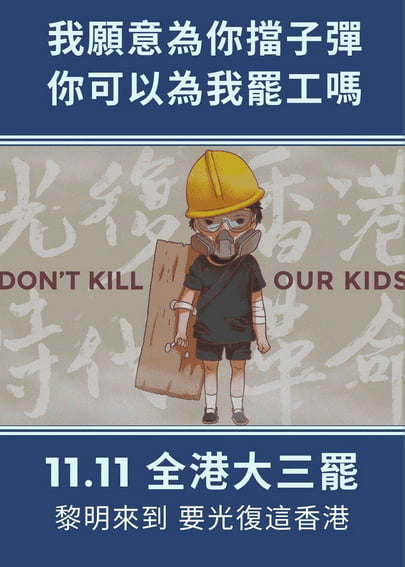
‘I am willing to take a bullet for you. Are you willing to go on strike for me?’
By then, a new umbrella group called the ‘Two Million Three Strike United Front’ (两百万三罢联和阵线), appeared on social media, posting news about forming unions and sharing new possible strategies. The group argued that a general strike had to be better organized at the workplace level. Quickly evolving into an umbrella organization for the new labor movement in Hong Kong, the new group’s first urgent task was to recruit more members. To attract public attention, union activists set up ‘joint union stands’ (联合跨站), each hoisting the flags of their unions. At a mass rally on January 1, 2020, several dozen union flags were raised behind a joint banner bearing the slogan ‘Trade Unions Resisting Tyranny’ (工会抗暴政).
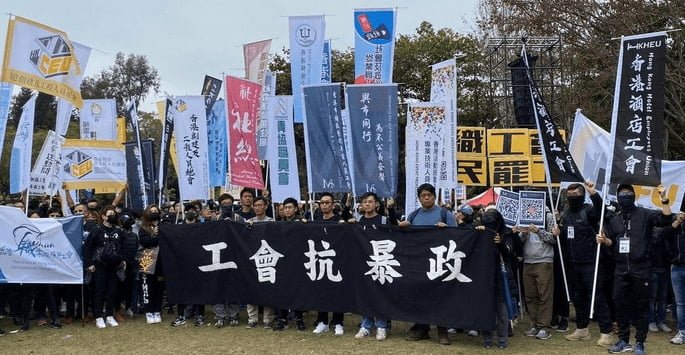
The new unions with their flags forming a united front at the mass rally of January 1 2020.
Photo credit: HKCTU, from the HKCT statement on International Workers’ Day 2020.
As most of the founding members of the new unions had little conception of workplace rights, trade unionism and labor laws, they invited labor lawyers and HKCTU staff to give seminars and training sessions and began to register with the government as unions. Gradually, the motivation for setting up unions became multidimensional, rather than single-mindedly focusing on supporting political strikes. Trade union leaflets soon included demands for shorter work hours, a higher wage, better benefits, fairer bonuses, and, not least, collective bargaining rights.
The second motivating force was to contribute to electoral politics. At the end of November 2019, the pro-democracy camp unexpectedly achieved a landslide victory in the District Council elections, winning a majority of the seats in 17 out of 18 of Hong Kong’s district councils. This was a big morale booster and highlighted the possibility that the pro-democrats might be able to take a majority of seats in the next two elections. The election for Hong Kong’s legislative council (LegCo) was scheduled for September 2020. In this election, half of the LegCo seats were controlled by the government, the other half, thirty-five seats were to be apportioned by popular vote of the “functional constituencies”. The second election, for the committee that selects the Chief Executive of Hong Kong, was expected to be held in June 2021.
In LegCo elections, the trade union “functional constituency” is apportioned three of the thirty-five “constituency” seats. Each registered union was to be given one vote under a winner-take-all system. This means that the larger the number of unions the protest movement could muster, the higher its chance of winning the three seats. Before 2019, the pro-Beijing HKFTU had dominated this constituency. The pro-democracy HKCTU, without resources to compete in registering so many unions, had preferred to prioritize workplace labor rights issues. For the new unions and their supporters, increasing the number of registered trade unions and expanding union membership became an urgent task. Fortunately, the procedure to register a new trade union in Hong Kong is simple. The minimum requirement is that seven people have to turn up at the Registration Bureau to apply to register a new union by trade, sector, or occupation. These initial seven organizers have to fill in forms stating the mission of the new union. Getting official approval usually takes about a month or two. Once approved, the founders have to hold a general meeting to elect an executive committee and the new union is then formally registered. This ease in registration explains the proliferation of newly registered pro-protest trade unions in a few short months. In fact, some activists started a group called ‘7 UP’ calling on those who could gather seven people to go to apply to set up a union. The Hong Kong and Chinese governments had been too confident that the pro-Beijing camp would continue to monopolize the registered union scene, since Hong Kong people had never expressed much interest in joining unions. In the new race to register trade unions, the pro-establishment camp also tried to create more new unions.
A Test of Union Solidarity with the Arrival of COVID 19
The question of whether the new unions that sprouted up during the protests could withstand political and management pressures presented itself at the end of January 2020. The coronavirus was spreading rapidly inside China and quickly penetrated Hong Kong through the many porous entry points at Hong Kong’s border with China. Hong Kong was not prepared to fend off the pandemic. Hospitals were short of beds, personal protective equipment, and medical personnel. The newly-formed Health Authority Employees Alliance (HAEA), which had been actively recruiting new members, by then had 18,000 union members out of the 80,000 medical and health personnel in the city. The HAEA called on the government to close the border with China out of concern for the public’s and their own safety. The demand to close the border was over a legitimate workplace occupational health and safety issue and had wide support from the public.
On January 31, 2020, Carrie Lam refused to consent, arguing this would mean discriminating against PRC citizens. The HAEA executive committee, led by a young chair, Winnie Yu (余慧明), who openly admitted that only half a year earlier she had only cared about enjoying a good life and had no idea about trade unionism, proposed to launch a two-stage strike. A vote was called, and on February 2 the motion was carried with 3,123 voting yes out of 3,164 ballots cast. 7,000 members, 17 percent of Hong Kong’s hospital-related medical sector, participated in the strike the next day. More than fifty unions came forward to support the strike. That same day, Carrie Lam announced all but three border crossings would be closed, but refused to budge further.
When the first stage of the strike ended after five days, HAEA called for a second vote on whether to continue the strike. For medical professionals to go on strike invariably invokes an intense moral dilemma. Having part of their demands met, 60 percent of the participants voted no, and the action was called off after that first success. The union leaders had displayed an impressive ability to organize a mass city-wide democratic industrial action at a critical moment on the eve of a pandemic. More so, it was led by a new generation of trade union leaders who had to challenge an adamant government.
After closing most of the borders, Hong Kong was able to control the pandemic. However, street activities in the city continued to decline as social distancing rules reigned and police suppression went unabated. In this relatively quiet period, the new unions prioritized three immediate tasks. First was to continue to set up street stations to recruit members at risk of being harassed by the police and pro-establishment activists. Second, as suppression at workplaces intensified, activist members who had incurred the anger of pro-establishment managers and supervisors sought advice and help from the unions. Third, the new unions strategized in preparation to contest against the HKFTU in the LegCo election that was scheduled to be held in September 2020.
The New Trade Unions and the Pro-Democracy Camp Primary Election
Whether the pro-democrats could gain a reasonable portion of the 70 LegCo seats assigned to the functional sectors would depend on whether the various tendencies in the movement could coordinate so that their candidates did not run against each other within the same electoral district, thereby diminishing their chance of defeating pro-establishment candidates. This necessitated a primary election from within the camp, which it was agreed would be organized by the protest movement. The various groups reached an agreement that the first five candidates in each of the five electoral districts who received the highest number of votes would be the pro-democrats’ candidates in the September 2020 election. Those who lost in the primary would promise to accept defeat and withdraw their candidacy.
The Hong Kong authorities warned the organizers that the primary election could be considered illegal, leading to serious consequences. Winnie Yu and the chairperson of HKCTU, Carol Ng, ran as candidates from the trade union sector in separate electorates. The police went around the city harassing the polling stations. The organizers ignored the threat and held the primary anyway on July 11 and 12 as scheduled. 600,000 people in defiance of the government’s warnings chose to line up patiently in the summer heat to cast their votes. The result was a big win for the young activists of the Valiant and Braves Faction who garnered the highest number of votes in the five electoral districts. This was a significant sign of mass support not just for the pro-democracy camp but specifically for the trust placed on the Valiant Faction. Winnie Yu won by a landslide, amassing 2,165 votes out of 2,856, against 186 votes for the current legislator for the health-service sector. Her courageous and well- organized leadership in the February strike had gained popular recognition. Carol Ng came in seventh in her electoral district, reflecting a new development in Hong Kong’s pro-democracy trade union movement—the changing of the guard to a younger, less experienced but determined and committed generation. The big turnout of the primary election was a warning shot to the pro-Beijing camp that it was likely to lose in the September election.
Within a few days 16 young successful candidates joined hands to form an electoral group called the “Resistance Faction” (抗争派). Among them was Winnie Yu. Soon after, one by one their candidatures and four sitting legislators were disqualified by the government on the grounds that they objected in principle to the NSL. A day later tThe government even postponed the September LegCo election to 2021, citing social distancing problems in a pandemic. The protest camp strongly suspected the real reason was the government’s belief its supporters would lose.
The Reckoning
In the late spring of 2020, even as they prepared to hold the primary election, it became public knowledge that China was planning to pass a National Security Law (NSL) to suppress opposition in Hong Kong. In June 2020, with the draft nearly ready, the new unions had to strategize how to deal with a looming crackdown. Undeterred by the threat, the unions decided to organize a general strike on June 20 to oppose the NSL. This general strike, unlike the previous three, was union-organized. A referendum among members on whether to go out on strike was scheduled, and thirty unions agreed to participate after seeking members’ approval. The slogan to be used during the strike would be ‘Recover Hong Kong; Join the Union; Union Revolution to Resist Tyranny’ (光复香港, 加入工会; 工会革命, 对抗暴政). The strike did not materialize, however, because only 9,000 union members cast their votes–even though 95 percent voted to strike.
The NSL was formally passed by China’s National People’s Congress on July 1, 2020. The law criminalizes secession, subversion, terrorism, and collusion with foreign powers. The moment the NSL was passed, the reckoning began methodically. Any sign of defiance, such as singing the Hong Kong protest movement’s anthem or walking in groups, or even a young person wearing a black shirt and carrying a backpack could result in police harassment and arbitrary arrest. Uniformed and plainclothes police are stationed throughout the city at street corners. People are anxious because the law is vague and there is no clear “red line”. Any action, or even thoughts, can be construed as having violated the offenses listed in the NSL. White terror reigns over the city.
What is less visible is retaliation at the workplace where the repercussions have included blacklisting, demotion, penalties, isolation or dismissal. Those who work in the civil service or government-funded or subsidized sectors are the most vulnerable. New recruits into the civil service have to take an oath to confirm they would uphold the Basic Law and swear loyalty to the Hong Kong government. Those who refused to sign would not be employed and could even be construed as subversive. Public servants who are already employed have to pledge loyalty.
The other most targeted sector is education. High school students’ active and innovative participation in the protest movement surprised and disturbed the Chinese and Hong Kong governments. About 3,000 of the over 10,000 people arrested since mid-2019 are secondary and university students. The Secretary of the Security Bureau of the Hong Kong government announced, “the foremost target is the education sector. The main task is to cleanse it of ‘bad apples’ to save the students from being poisoned” He was confident that this could be achieved in one or two years. No time has been lost in ordering schools to forbid students from joining protest groups. Urgent measures have been rolled out to prevent a generation of primary school students from identifying with the rebellious older cohorts. Textbooks, particularly those used for courses in social science and humanities, are scrutinised, changed and revised. Teachers and staff have to acknowledge loyalty to China and the Hong Kong government. Above all, parents and students are encouraged to report on teachers who are deemed to have deviated from the official line. Up till August 2020 there were 247 complaints against teachers. Two primary school teachers quickly lost their teaching licences for introducing ideas of democracy and making “factual errors” about Chinese history. Both the new and established education trade unions criticised the government for political censorship but to no avail.
Controls were exerted to curtail freedom of the press. The owner of Apple Daily, the most popular pro-democracy Chinese-language newspaper, was arrested and charged in September. A new policy gives police the power to decide whether a journalist is eligible for a press pass. This means a large number of journalists working for electronic newspapers, student journalists, and freelance journalists are not recognized as journalists, depriving them of legal protection while covering news. They can be beaten up, arrested and charged as if they are protesters. To the police, journalists are considered enemies because they had reported about police violence on the front lines. Various media-related institutions stepped forth to protest and demanded the new policy should be repealed. At the time of writing it is unclear how this will be resolved.
In the medical and health sector the Hospital Authority sent out letters in October to those who were absent on the days of the strike in February demanding they explain their absence. Winnie Yu hurriedly advised her members not to sign until the union has sought legal advice. Meanwhile the union organized a petition signed by 5000 members arguing that the healthcare strike was legal and demanding that the bureau meet with the union. The petition was presented in person to the bureau chief to underscore the legitimacy of their industrial action.
My communications with sources in Hong Kong and my reading of the protest movement’s on-line media reveal that in these and other job sectors, a fair number of union members–scared, feeling isolated, unclear as to where the red-line is, not knowing how to act in a tightening workplace culture, and forced to show loyalty to the Hong Kong and Chinese governments against their own conscience—are seeking advice from the unions.
For the time being the pro-establishment ruling elite is busy rolling out suppressive counter-measures against the pro-democracy movement’s ‘revolution of our times!’ (时代 革命), which Beijing condemns as a ‘color revolution.’ The prognosis for the new trade unions is not bright. Deregistering or suppressing the pro-democracy trade unions has not yet begun. Their voices through institutional channels have already been muffled, though. In November, through manipulation of the election for the Labour Consultative Committee, all five committee seats are now monopolized by pro-establishment unions. The “Two Million Three Strike United Front” continues to provide an on-line platform to hold the movement together. It is clear that some of the new union members are demoralized. Some are determined to push on. What is to be done? For the time being, it is generally agreed that the pro-democracy camp should lie low and re-emerge when a chance presents itself.
This is a revised and expanded version of an article published in the Vol 5, Issue 2 February 2020 edition of Made in China under the title “From Unorganised Street Protests to Organising Unions: The Birth of a New Trade Union Movement in Hong Kong.”
Doi.org/10.22459/MIC.06.02.2020.08
Leave a Reply
You must be logged in to post a comment.