• Skip to main content
  • Skip to primary sidebar
  • Skip to footer
  • Home
  • TP について/About
  • Topics/トピクス
    • Gender/ジェンダー
    • Globalisation/グローバリゼーション
    • Japan and Asia/日本とアジア
    • Japanese/日本語
    • Media/メディア
    • News/ニュース
    • Social Justice/社会正義
    • War and Empire/戦争&支配権力
    • Environment/環境
    • Other Stories/他の記事
  • Links/リンク
  • Contact

TokyoProgressive

Linking Progressives East and West Since 1997

東西のプログレッシブをつなぐ − 1997年設立  |  Linking Progressives East and West Since 1997

Featured Stories/ 特集記事

This month's articles/今月の記事)    JAPANESE/日本語    JAPAN AND ASIA/日本とアジア    GENDER/ジェンダー   SOCIAL JUSTICE/社会正義    ENVIRONMENT/環境   WAR AND EMPIRE/戦争&支配権力   GLOBALISATION/グローバリゼーション

NEWEST STORIES/最新の記事

左派と資本主義の間のデジタル格差を埋める、左派の緊急の使命

January 24, 2026 By tokyoprogressive Leave a Comment

左派は現在、技術を階級闘争の主要な戦線ではなく二次的な関心事として扱っているため、戦いの一部で敗れています。しかし、この戦いはまだ終わっていません。勝利はスローガンからではなく、技術の意識的かつ効果的な活用に基づくビジョンを実践的なプログラムに変え、資本主義のデジタル支配に対抗する実行可能な代替案を提供することから生まれます。左派は防御的な立場にとどまってはならない。技術闘争に積極的に参加し、技術の受動的な利用者ではなく、未来を再形成する力となる明確な戦略を掲げなければなりません。

Bridging the digital divide between the left and capitalism, an Urgent Mission for the Left

January 24, 2026 By tokyoprogressive Leave a Comment

The left is currently losing part of the battle because it still treats technology as a secondary concern, rather than as a primary front in the class struggle. But this battle is not over. Victory will not come from slogans but from turning vision into practical programs, based on the conscious and effective use of technology and on offering viable alternatives to capitalist digital dominance. The left must not remain in a defensive position. It must actively engage in the technological struggle with a clear strategy—one where it is not a passive user of technology but a force reshaping its future.

デジタル社会主義か絶滅か:資本主義の最も激しい段階におけるベネズエラの教訓

January 24, 2026 By tokyoprogressive Leave a Comment

ベネズエラで起きたことは、現代史の中で孤立した例外的な出来事ではありません。これは、世界のさまざまな場所で進化し繰り返されている包括的かつ統合的なデジタル資本主義戦略の不可欠な一部であり、街頭や広場での闘争と並行してデジタル闘争で用いられています。マドゥロ逮捕事件から得られる最も厳しく明確な教訓は、現在の資本主義がもはや伝統的な強硬な軍事力だけに頼っているわけではなく、必要に応じてそれを保持し使用しているということです。

Digital Socialism or Extinction: Venezuela’s Lesson amid Capitalism’s Most Ferocious Phase

January 24, 2026 By tokyoprogressive Leave a Comment

The harshest and clearest lesson from the incident of Maduro’s arrest is that capitalism in its current stage no longer relies only on traditional hard military force, although it still retains and uses it when necessary. It has developed a complex and intertwined digital system capable of penetrating geographical and political borders, monitoring individuals and groups with amazing accuracy, manipulating information and shaping public awareness in ways that were not possible in any previous era, and restricting and paralyzing leftist and progressive movements before they reach the stage of real danger to its interests.

資本に奉仕する人工知能か、それとも解放のためのツールか?

December 10, 2025 By tokyoprogressive Leave a Comment

人工知能に対する資本主義の支配は、もはや生産関係の再現にとどまらず、支配と政治的抑圧の直接的なツールにもなっている。今日、人工知能は、大量監視システム、顔認識、個人やグループの政治的行動の分析などに使用されています。これにより、抑圧的な政権は、いわゆる民主主義国であっても、事前に確立された「レッドライン」を越える、つまり資本主義システムの構造に深刻な脅威をもたらす潜在的な急進的な左翼の抵抗を弱体化または阻止するために先制的に介入することができます。

Artificial Intelligence in the Service of Capital or a Tool for Liberation?

December 10, 2025 By tokyoprogressive Leave a Comment

… Just as machines were used during the industrial revolution to intensify exploitation instead of reducing working hours, artificial intelligence today is employed in automation to lower production costs and reduce the need for human labor in most cases, imposing more precarious and less secure working conditions.

This also deepens alienation, as manual and intellectual workers are turned into human tools in their workplaces and replaced by algorithms, which leads to increased unemployment or forces them to seek alternative work.…

DT’s first moves deepen world instability

February 19, 2025 By tokyoprogressive Leave a Comment

The following article has encountered difficulty when linked from social media. For example, FB says it (but not other articles from the same site) is spam and removes the link from posts and comments as of Feb 19, 2025.  If you are having trouble. feel free to link to this. Trump’s ‘shock and awe’ offensive […]

「選択する必要がある」 :イスラエルが病院を標 的にする中、マッズ・ギ ルバート医師がガザとの 医療連帯を語る

November 3, 2023 By paul arenson Leave a Comment

DR.マッツ・ギルバート:昨日、シファの同僚から報告を受けました。医療スタッフが熱を出している。疲労困憊しているからかもしれないが、合理的に考えれば、感染しているからだろう。1万人、2万人、3万人の人々が非常に密集した空間に詰め込まれ、十分なトイレもなく、手を洗うための十分な水(水道水)もなく、赤ちゃんを清潔にすることもできず、傷口を清潔にすることもできなければ、さまざまな症状を引き起こす病原体が蔓延することになる。胃や腸から下痢や嘔吐が起こり、赤痢菌やサルモネラ菌、その他の消化器系感染症の原因菌によって引き起こされる。これは大きな問題だ。そして、すでに私たちはそれを目の当たりにしている。

「これは止めなければならない」:イスラエルによるガザ病院襲撃を糾弾する医師たち

November 3, 2023 By paul arenson Leave a Comment

イスラエルの空爆がガザの病院をさらに襲うとの警戒が高まるなか、ガザの医療システムとイスラエルによる主要病院の避難命令について、2人の医師に話を聞いた。ガザのアル・アハリ・アル・アラビ病院の整形外科部長であるファデル・ナイム医師は、イスラエルは「病院周辺を爆撃した」と言う。40年以上にわたってガザで救急外傷治療に携わってきたマッズ・ギルバート医師は、イスラエルが証拠もなしに軍事活動の疑惑を利用して市民病院を攻撃したことを非難する。”これはすべて、ガザのパレスチナ人に対する甚大な威嚇の一環なのです “とギルバート医師は言う。”パレスチナ人への具体的な連帯を示すために “エジプトから包囲された領土に入ろうとしているのだ。

“Decontaminated” soil from Fukushima to be spread far and wide

January 19, 2023 By paul arenson Leave a Comment

This is how the Japanese government almost literally sweeps the problem of nuclear contamination under the rug. Note how the standard for safety has been relaxed to allow this to take place. Original article appears below the translation. While the Kishida administration is pushing for a “return to nuclear power,” the current situation in Fukushima […]

‘You Have to Learn to Listen’: How a Doctor Cares for Boston’s Homeless

January 15, 2023 By paul arenson Leave a Comment

A rare NY Times story about the evolution of a care house and eventual mobile  clinic for rough sleepers in Boston founded in the 1980s by feminist nurses in response to the way street people were treated by a paternalistic medical system. Told through the eyes of the clinic’s first doctor, he learned to listen, […]

Left Sectarianism and Ukraine

December 17, 2022 By paul arenson 1 Comment

Vets for Peace members have visited Okinawa in solidarity with the resistance movement against American bases. Will other VFP members uncritically supporting Putin or Nato spell an end to the anti-war movement itself and mean that Okinawans and Palestinians must henceforth go it alone? Pro Putin and pro American military positions on the part of some members of peace organizations might just bring that day closer.

An Epitaph for Kishida’s New Capitalism

December 15, 2022 By paul arenson

The Kishida government has declared that all Japan taxpayers have a “responsibility” to support its policy of dramatically increasing military expenditures, accepting the premise that Japan’s neighbors are likely to launch an armed attack unless deterred from doing so. This marks the effective end of “New Capitalism.”

added to Tokyoprogressive Jan 27

December 27, 2021 By paul arenson Leave a Comment

We will then try to move to turnlefthosting

'We Did It!': Eruption of Joy as Argentine Senate Passes Bill to Legalize Abortion

December 30, 2020 By Leave a Comment

  From CommonDreams Published on Wednesday, December 30, 2020 by Common Dreams 'We Did It!': Eruption of Joy as Argentine Senate Passes Bill to Legalize Abortion “This is a victory for the women’s movement in Argentina, which has been fighting for its rights for decades.” by Jake Johnson, staff writer 0 Comments Pro-choice activists celebrate […]

Shane Dismisses Leading Labor Union Organizers

December 30, 2020 By Creative Minds

From Shingetsu News Agency   Calendar December 2020 M T W T F S S   1 2 3 4 5 6 7 8 9 10 11 12 13 14 15 16 17 18 19 20 21 22 23 24 25 26 27 28 29 30 31  

Ending Poverty in the United States Would Actually Be Pretty Easy

December 30, 2020 By Leave a Comment

  From Jacobin FQ Almost immediately in this book, you confront the maxim, “Give a man a fish, and you feed him for a day; teach a man to fish, and you feed him for a lifetime”: “Antipoverty efforts should stop making assumptions about people’s fishing abilities,” you write. “It’s past time to stop judging […]

The Demand for Student Debt Cancellation Should Be Paired With Tuition-Free Public College

December 30, 2020 By Leave a Comment

  From Jacobin Just earlier this year the nation was compelled to weigh the merits of a full student debt jubilee, as proposed by presidential candidate Bernie Sanders. Crucially, he proposed this reform alongside others to higher education, including tuition-free public college and trade school. But Sanders lost, and while the issue of student debt […]

Georgians Are Starving — And Their Millionaire Senators Refuse to Force a Vote on Aid

December 30, 2020 By Leave a Comment

  From Jacobin Loeffler and Perdue Could End This, but They Refuse Loeffler and Perdue are in a position to immediately end this battle right now, if they chose to actually use their power. Senator Mitch McConnell may want to own the libs and economically punish his own destitute state by blocking the $2,000 checks, […]

A Deportation Moratorium, What Comes Next for Biden?

December 29, 2020 By Leave a Comment

  From CommonDreams Published on Tuesday, December 29, 2020 by Speak Freely / ACLU A Deportation Moratorium, What Comes Next for Biden? A deportation moratorium is a critical step to repairing the harm that has been waged against our immigrant communities and reimagining our existing system. by Madhuri Grewal 0 Comments The Biden-Harris administration committed to an […]

2020 Has Shown Us the Way Forward

December 29, 2020 By Leave a Comment

  From CommonDreams You must find a way to get in the way. You must find a way to get in trouble, good trouble, necessary trouble.”— Rep. John Lewis Three people in my family passed away this year within four months of each other: my brother-in-love, from an 18-month battle with cancer; my closest maternal […]

Biden to Invoke Defense Production Act for Vaccine Manufacture. Trump? Playing Golf at Mar-a-Lago

December 29, 2020 By Leave a Comment

  From CommonDreams Published on Tuesday, December 29, 2020 by Informed Comment Biden to Invoke Defense Production Act for Vaccine Manufacture. Trump? Playing Golf at Mar-a-Lago Trump really just doesn’t care. by Juan Cole 0 Comments President Donald Trump makes a phone call as he golfs at Trump National Golf Club on November 26, 2020 […]

After Years of Mass Organizing, Argentina Could Legalize Abortion Tomorrow

December 29, 2020 By Leave a Comment

  From Jacobin On December 11, after more than twenty consecutive hours of debate, the lower house of the Argentine congress voted to legalize abortion. The upper house will vote on December 29. If the law is approved, Argentina will join Uruguay and Cuba as the third country in Latin America to allow abortion without […]

How Amy Coney Barrett and Barack Obama Transcended Petty Partisanship to Crush Community Activists in Chicago

December 29, 2020 By Leave a Comment

  From Jacobin Proving that architectural narcissism isn’t a quality limited to the outgoing forty-fifth president, Barack Obama is currently attempting to erect a hideous 235-foot tower, a monument to himself and his presidency, in a park in Chicago, over the objections of community groups. Local organizations fighting the project recently suffered a defeat at […]

Austerity Is Looming in New York. Is Ray McGuire the Mayor to Carry It Out?

December 29, 2020 By Leave a Comment

  From Jacobin “Only bankers and businessmen could cure the situation,” observed John Kenneth Galbraith in 1977, for “[t]heirs indeed was a special, even magical, talent where money was concerned.” Galbraith was sarcastically describing the popular mythology surrounding New York’s City fiscal crisis of the mid-1970s, which saw Wall Street impose a neoliberal austerity agenda […]

This month's articles/今月の記事)    JAPANESE/日本語    JAPAN AND ASIA/日本とアジア    GENDER/ジェンダー   SOCIAL JUSTICE/社会正義    ENVIRONMENT/環境   WAR AND EMPIRE/戦争&支配権力   GLOBALISATION/グローバリゼーション

Top Menu/トップメニュー

JAPANESE/日本語

U.S. veterans to request GAO investigation of Henoko base construction/辺野古新基地建設地、米側が調査を 元軍人の会 来月の総会で決議提起

August 14, 2019 By tokyoprogressive

Veterans for Peace—Ryukyu Okinawa Chapter Kokusai (VFP-ROCK) President Douglas Lummis and members held a press conference at Okinawa’s prefectural press club on July 25. The group announced VFP-ROCK’s intentions to submit a new resolution for approval at the 34th National Convention of Veterans For Peace, which will be held in Spokane, WA next month. They seek to halt the construction of the new base in Henoko, Nago City with the new resolution.

九州20ヵ所猛毒除草剤埋設 ベトナム戦争の枯れ葉剤成分 (Dioxin buried around Japan)

August 23, 2018 By tokyoprogressive

Japanese government buried  2,4,5-Trichlorophenoxyacetic acid produced at Omuta factory all around Japan. Kitakyushu City University researcher speculates it was Japanese government policy to sell this chemical to the US military for use in the production of Agent Orange by mixing with 2,4-D-dichlorophenoxyacetic acid. Official use, according to the government, was to control weeds in the […]

More JAPANESE/日本語

This month's articles/今月の記事)    JAPANESE/日本語    JAPAN AND ASIA/日本とアジア    GENDER/ジェンダー   SOCIAL JUSTICE/社会正義    ENVIRONMENT/環境   WAR AND EMPIRE/戦争&支配権力   GLOBALISATION/グローバリゼーション

Top Menu/トップメニュー

JAPAN AND ASIA/日本とアジア

Debating Maoism in Contemporary China: Reflections on Benjamin I. Schwartz, Chinese Communism and the Rise of Mao

December 24, 2020 By Leave a Comment

  From Japan Focus   Abstract: Xi Jinping’s frequent references to Mao Zedong, along with Xi’s own claims to ideological originality, have fueled debate over the significance of Maoism in the PRC today. The discussion recalls an earlier debate, at the height of the Cold War, over the meaning of Maoism itself. This paper revisits […]

Speakeasy: Opposition Party Consolidation

December 22, 2020 By Creative Minds Leave a Comment

From Shingetsu News Agency   Calendar December 2020 M T W T F S S   1 2 3 4 5 6 7 8 9 10 11 12 13 14 15 16 17 18 19 20 21 22 23 24 25 26 27 28 29 30 31  

More Posts from JAPAN AND ASIA/日本とアジア

This month's articles/今月の記事)    JAPANESE/日本語    JAPAN AND ASIA/日本とアジア    GENDER/ジェンダー   SOCIAL JUSTICE/社会正義    ENVIRONMENT/環境   WAR AND EMPIRE/戦争&支配権力   GLOBALISATION/グローバリゼーション

Top Menu/トップメニュー

China Shoots the Moon

December 2, 2020 by Leave a Comment


From Japan Focus

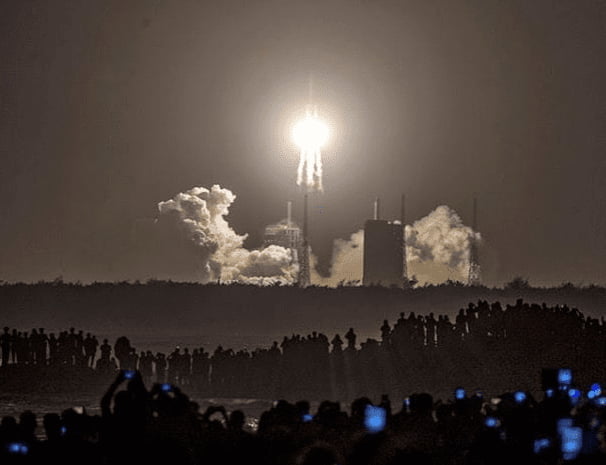
November 23, 2020 launch of China’s Chang’e-5 from Wenchang Satellite Launch Center in Hainan

Abstract: With China’s Chang’e 5 rocket launch, which landed on the moon on December 1, the long US-Russian domination of space has a major challenger. The issues extend beyond national pride to a global leadership initiative in rocketry whose implications extend to military, economic and diverse scientific applications at a time of mounting US-China rivalry in all spheres.

Keywords: China, US, Russia, Space Program, Great Power Conflict


China’s Challenge to US-Russia Space Exploration Hegemony

China is taking aim at the moon, establishing itself as a space power to be reckoned with. While currently playing catch-up behind the space accomplishments of the US and Russia, it is rapidly gaining ground as a result of an ambitious Chinese space program coinciding with domestic squabbling in the US, budgetary shortfalls in Russia, and lack of focused political will on the part of both space pioneers. 


With the freshly-launched Chang’e 5 probe, locked into a moon orbit as of November 28, for the first time in forty years an attempt is being made to collect rocks on the moon and bring them back to earth for study.


The US Advance in Space and its Subsequent Decline

The heyday of moon exploration by the US and the USSR in the 1960s and 1970s coincided with a deadly serious space race that was effectively war by other means for the two reigning superpowers. With the epoch-setting launch of Sputnik, the USSR got off to a roaring start, putting the first man in space, the first woman in space and achieving a long catalogue of other firsts. Energized by the Kennedy challenge to put a man on the moon by the end of the decade, the US doubled down on investments in education and science, while the daunting technical requirements of the space program drove demand for silicon chips, miniaturization and other novel technologies. 

On July 20, 1969, the small step of one man was memorably deemed “a giant leap for all mankind,” but that noble sentiment did not stop Armstrong and Aldrin from planting an American flag on the moon, propped up artificially to make up for the utter absence of a breeze. 

But winning the race to the moon in 1969 proved as anti-climactic as “winning” the Cold War in 1989. Both successes fueled American exceptionalism and nationalistic hubris, and possessing the high ground did nothing to deter the US from engaging in cruel and gratuitous warfare, above all in defeat in Vietnam. The same kind of ballistics and chips that enabled space flight were retooled to power cruise missiles, smart bombs and drones. A smug and careless complacency set in, rooted in narcissistic self-esteem and a generalized disregard for all rivals.

The audacious derring-do of those early days is underscored by the paucity of computing power back then: the Apollo program sent men to the moon to hand-collect bags of rocks using computer systems and cameras less powerful than the average teenager’s smart phone of today. 

If the early programs lacked digital prowess, they were notable for pluck and excellent rocketry. The big rockets of the day, the Saturn and the Proton, developed with the help of former Nazi scientists on both sides of the Soviet-American divide, made the reach to the moon possible.

Computing power has grown by leaps and bounds since then, but US rocketry has declined to the point that NASA had no way to send or retrieve astronauts in space for a decade, dating from the retirement of the Space Shuttle in 2011. Until the advent of the Space X Crew Dragon earlier this year, US astronauts had to hitch a ride on Russia’s Soyuz craft to access the US-built space station.

 

Space X Crew Dragon Demo-2


The exploits of astronauts and cosmonauts offer nail-biting narratives and crowd-pleasing photo ops, but with today’s advanced computer technology and robotics, unmanned missions suffice for most scientific purposes. 


What scientific value space exploration?

During NASA’s slack years, a diverse series of unmanned spacecraft supervised by the US Jet Propulsion Lab conducted cutting-edge science, not only uncovering the unique attributes of various planets and satellites, but going a long way to help us understand related processes on earth. To gaze at other planets, is to ponder the past present and future of our own planet and the universe.

What caused Mars to lose its atmosphere and streams of liquid water? What was Venus like before a runaway greenhouse effect produced some of the hottest temperatures in the solar system? The Jovian moon Europa and Saturn’s Titan, the one containing an ice ocean, the other a thick atmosphere, seem to possess the necessary conditions for the genesis of biological life as we know it.

Which brings us back to the moon, that lonely desiccated, cratered satellite locked in orbit with the watery planet earth. The birth of the modern environmental movement was in part inspired by the Apollo astronaut’s view of earth from afar; how fragile, how delicate, how alone. 

The last man to walk on the moon, Eugene Cernan, packed up his bag of rocks in 1972, and no one’s been back since. The Soviet Union’s Luna mission, a robotic craft designed to ferry a few ounces of moon rock back to the earth, last flew in 1976.

Going to the moon for a walkabout might seem old hat but there’s still much science to be done, geology in particular. Studying rocks in a volcanic basin on the moon is the ostensible purpose of the Chang’e-5 mission, though the fact that uranium is thought to be abundant there is enough to imbue China’s modest automated rock collection mission with an aura of clandestine intrigue at a time of US-China clash on numerous fronts.



Xinhua graphic of Chang’e 5 entering moon orbit


The Moon and Mars

But what the latest Chinese lunar probe is really about, though not explicitly stated, is Mars. If humankind is ever going to get to the Red Planet, competition for national prestige is likely to be a key driver. 

Deadly solar radiation, unmitigated by either atmospheric or magnetic deflection, means that Mars, science fiction visions notwithstanding, is more likely to remain a lighthouse, a lonely scientific outpost, than an “empty planet” ripe for colonization. In either case, the long Mars journey requires mastery of challenging modular maneuvers that start with blast-off from earth, descent to another heavenly body, ascent back into space and safe propulsion back to the home planet. 

China’s moon missions can be seen as a dry run for Mars-capable technology. Moreover, the moon also provides a viable, and relatively economical site from which to launch a Mars mission, whosetechnical requirements are too taxing for any current earthbound rocket to consider for purposes of direct human travel.

The Chang’e series of moon shots has made China a creditable moon power, first achieving a lunar orbit in 2007, followed by successful soft landings in 2013 and 2018. In January 2019, the Chang’e 4 made a daring landing on the far side of the lunar orb. This unprecedented mission required close coordination with the Queqiao, a lunar communication relay satellite that is required to keep the isolated landing craft, which remains permanently out of earth view, in touch with radio waves from the home planet.  

The current Chang’e-5 mission, launched November 24, 2020, promises to cement China’s status as a leading space power if it succeeds at its rock-collecting task.


 China’s Historical Interest in Space Travel

China may be a late arrival to the space race, long dominated by the US and Russia, but not for lack of imagination. Literary legend Lu Xun translated “From the Earth to the Moon” by Jules Verne at the dawn of the twentieth century and dabbled in science fiction with his own “Yuejie luxing bianyan” or “Journey to the Moon,” hoping to promote an interest in science. Decades before China ventured into space, writer Mao Dun credited the traditional legend of moon goddess Chang’e (after which the latest line of moon craft is named) as a powerful native archetype for lunar exploration. 

The Queqiao satellite references the “Magpie Bridge” in the Chinese legend of the Cowherd and Weaver, which is celebrated on the 7th day of the 7th lunar month, while the Yutu, or “jade rabbit” Rover refers to the steady companion of moon goddess Chang’e.

When Sputnik, the world’s first man-made satellite was launched, Mao Zedong hinted that Chinese satellites would follow. He joined Khruschev to hail the flight of Sputnik II which was launched during his 1957 Moscow visit, carrying space dog Laika on a lamentable one-way journey. 

 

Mao and Khruschev in Moscow in July 1958


Subject to serious disruptions due to the onset of the Cultural Revolution, China did not launch its own satellite, Dongfanghong 1, until 1970. It then famously beamed the iconic tune “East is Red” back to earth, but there was little follow up due to continued political distractions and economic constraints. 

By May 1971, just before Mao’s second-in-command Lin Biao met his demise in a mysterious plane crash over Outer Mongolia, China’s Chairman revealed to visiting Romanian head of state Nicolae Ceaușescu that China had neither the capabilities nor interest to go to the moon. 

Premier Zhou Enlai then reportedly cut in to say, “It doesn’t even have air or water… The problems on earth haven’t been solved, but they want to go up to the moon, it’s ridiculous.”

Zhou makes a valid lament about conditions on earth, but there may also be a touch of sour grapes to the dismissive comment about the US space program, coming as they did during the peak of the stunningly successful Apollo series of missions. 

Fast forward 50 years and China, thanks to a booming economy and prudent investment in science, is a contender in technology and space. If everything goes according to plan, the Chang’e 5 lunar lander will scoop up rock samples from a lunar crater and return several kilograms of geological treasure to the Earth in late December. 


China’s Chang’e Moon Program


The 18,000-pound craft, launched successfully by a Long March 5 rocket from a base on Hainan Island on November 23, is divided into four sections. It includes a service module and a “returner” capsule designed for re-entry to earth along with a lunar lander and lunar ascender. The latter pair of units will land on the moon while the other pair will remain in moon orbit until it is time to return to earth. 
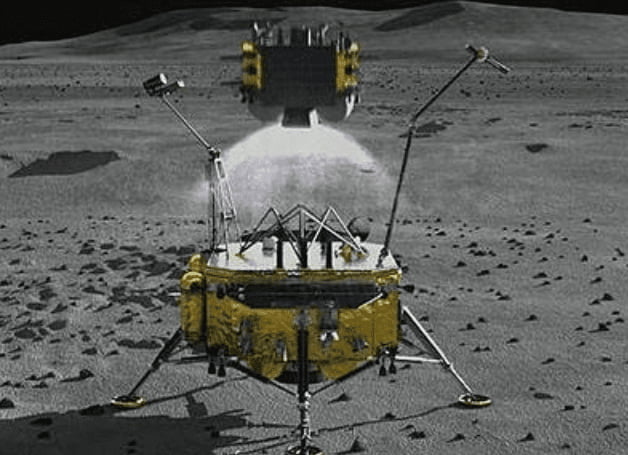
 

Simulation of Chang’e lunar ascender lifting off from lunar lander


After the moon lander takes measurements and collects samples on the lunar surface, the ascender section will then be shot back into lunar orbit, using the base of the lander as a launch pad, echoing the modular design of the Apollo lunar craft. The “returner” capsule is designed to catapult through earth’s atmosphere, using a “skip re-entry” to slow down for a parachute landing in Inner Mongolia. 

It’s a complicated mission that requires a tricky lift-off from the moon, orbital docking, an automated transfer of materials from the ascender to the return capsule and a high-velocity return to earth. A single failure anywhere in the complex chain of necessary tasks could end the costly effort instantly. Space travel remains a high-risk endeavor. Indeed, the Chang’e 5, experienced a three-year mission delay due to the July 2017 explosion of a Long March rocket resulting from a first-stage booster failure.

 

Heavy-lifting Chang Zheng (Long March) rocket in flight


The Chang’e 5 craft is targeted to land in a lunar volcanic plain known as Oceanus Procellarum. NASA’s Apollo 12 and other craft landed in that same general region half a century ago, but this mission will focus on a particular volcanic formation known as Mons Rumker. It successfully landed on December 1.

 

Chang’e 5 moon landing, December 1, 2020


The aim of the probe is to drill, dig and analyze relatively pristine lunar rock, (just over a billion years old) in contrast to the Apollo mission samples which have been dated at 3 to 4 billion years old. This seemingly arcane task will help geologists establish benchmarks for dating ancient rock on earth as well, where erosion from wind and water has irrevocably altered the surface. 
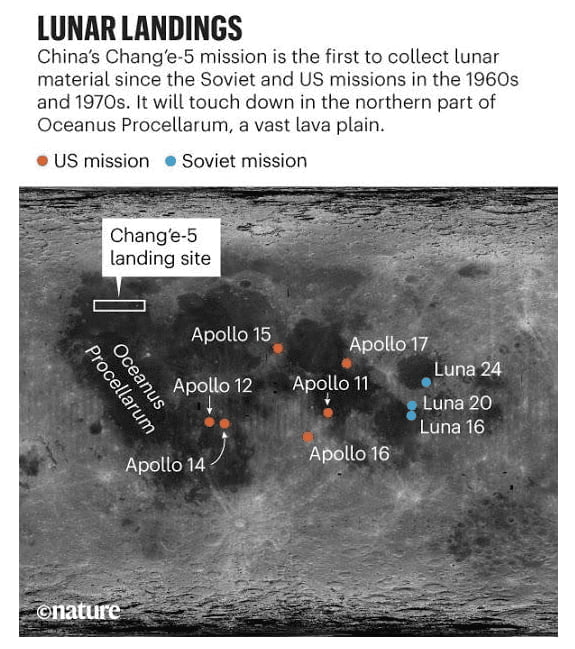


The Chang’e 5 mission is an abbreviated one, scheduled to last a single day on the moon, a lunar day that is, which amounts to two weeks earth time. It will study its landing site with ground-penetrating radar, panoramic cameras, and an imaging spectrometer.

Once the sun sets below the cratered horizon of Oceanus Procellarum, an unimaginably cold night follows, with temperatures dropping to a minus 232 degrees centigrade. Chang’e, covered in reflective foil, is designed to handle the scorching day-time temperatures of 120 degrees centigrade, but being solar-powered, it is not equipped to deal with a deep freeze lasting a fortnight. During the Apollo program, manned visits were timed around lunar dawn and dusk when the shadows are long, the surface is in high contrast and temperatures are in transition from very hot to very cold.

If Chang’e 5 proves a success, an almost identical model, the Chang’e 6, will aim to land near the south pole of the moon. The lunar polar area, with its oblique shadows and angled sunlight, contains murky craters likely to contain water in the form of ice. Elsewhere on the moon, the searing radiation of sunlight causes the instant sublimation of water and ice into the atmospheric vacuum, preventing any accumulation. 

The shadowy pole area is deemed uniquely suitable for a potential moon base due to the likely presence of water, which is too heavy to transport from Earth but is vital for survival. Water can be used to produce food, rocket fuel, and breathable oxygen, and a layer of ice, if available in abundance, offers natural shelter from deadly solar rays. 



Super-Power Competition or Cooperation in Space?

China’s entry into a field long dominated by the US and Russia is reinvigorating the moribund competition of moon travel. It’s also raising the important question of whether it’s better to work together or go it alone. Protectionist US politicians, fearful of technical espionage, banned China from the US-led Space Station in 2011. The Wolf Amendment, also known as the China Exclusion Policy, was proposed by Republican Senator Frank Wolf, and passed into law despite objections from NASA and scientific researchers. The amendment specifically targets China; its prohibitions on the sharing of space science are not extended to Russia, Japan or any other nation. 

Being thus snubbed, China has set into motion plans to construct its own space station, the Tiangong, (Heavenly Palace) which may be the only viable station orbiting earth when the creaky International Space Science Institute station is retired at some point in the next few years. 

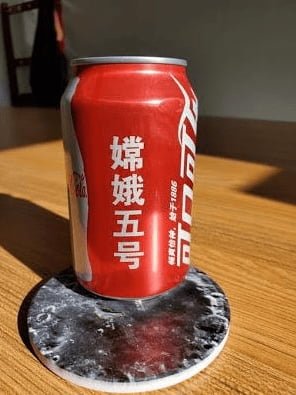
The International Space Science Institute in Beijing posted a picture of a commemorative Coca Cola, American in origin, celebrating the Chang-e 5 mission, but will Americans be welcome aboard the Tiangong and allowed to share the fruits of this historic mission?


According to Russia Today, the US is pressuring China to allow “the global scientific community” access to any newly-gained moon rocks and other research findings. But that’s just Russia Today gently trolling the US for its exceptionalist arrogance. 

The same mean-spirited Wolf Amendment of 2011 that denies China access to the space station ironically denies the US access to moon rocks and scientific findings from China’s current moon missions as well. 

While Newton posited that science necessarily involved borrowing, that is, standing on the shoulders of giants, and every developing and technologically advanced nation has done its own borrowing, lifting or stealing technology to get where it is today, it seems the US attitude these days is to “build a wall” to keep the science and technology of rival countries apart, as witnessed in the fierce US ban Huawei and the fight to control 5-G standards. In the jaundiced view of the US security establishment, the only thing worse than “backward” China copying US technology is a competent and advanced China outperforming the US in science and tech, as the Huawei case illustrates.

Certainly, vigorous arguments can be made pro and con for nuanced measures designed to limit the “stealing” of copyrighted technology, but the infelicitous unintended results of banning cooperation with China, and China alone, on the part of the US Congress are only beginning to be felt.

As if to justify the pre-existing hostile stance, the US national security establishment is casting a wary eye on the Chang’e program. Space Force General John Raymond sees Chinese success in space as a threat to US hegemony. The same rocket science that lifts Chang’e into orbit can carry missiles, and the same kind of precision and control of satellite technology as used in the moon shot can theoretically be deflected to disable US satellites and thus disrupt communications, if not the entire GPS system. 

US Air Force veteran Raymond, who was deployed in both the war in Iraq and Afghanistan, illustrates this risk with hypocrisy, castigating China for its 2007 kinetic kill (deliberate collision) that involved targeting its own weather satellite, even though the US has experimented with its own satellite-killing technology since the 1960s. Both nations are well aware that intercept and “kill” technology has possible military applications, though it can also be used to push malfunctioning craft into a fiery, self-obliterating descent to earth.

On February 21, 2008 President George W. Bush authorized the shoot-down of a US satellite with an attack missile launched from the deck of the USS Lake Erie missile cruiser. A bravado show of US technical prowess, the militaristic “kill” of spy satellite USA 193 was spun in US government press releases as being an environmentally-friendly “clean-up.” It was supposed to reduce the risk of toxic hydrazine fuel and space debris returning to earth, though it ended up creating a debris cloud which led to launch delays of other craft. The exercise earned a rebuke from Russian defense observers unimpressed by the phony cover story.
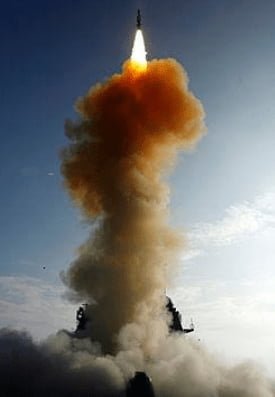
 

SM-3 missile that intercepted USA-193 (Wiki)


US General Raymond concludes that space “underpins all our instruments of power” and warns that Russia and China will cooperate against American interests. There’s more than a whiff of self-fulfilling prophecy in Raymond’s prognosis. Thanks to the Wolf Amendment and earlier restrictions, China’s program, by necessity, has hewed close to Russian prototypes. The Shenzhou capsule, for example, is modeled after the sturdy and dependable Soyuz craft. 

On the other hand, history shows that Sino-Russian cooperation is not a given. Shortly after Mao met Khruschev in Moscow, extolling bilateral solidarity, diplomatic relations between the two powers went into freefall, and it wasn’t until the end of the Gorbachev era that cooperation got back on track. Meanwhile, the US and Russia have cooperated not just in the realm of space science and shared use of the Space Station, but in nuclear disarmament. 

 

Soyuz


Shenzhou


US go-it-alone pride and intransigence in the era of America First has surely played a part in pushing Moscow and Beijing closer together. Likewise, hostility towards all things Chinese threatens not just commerce and diplomatic cooperation, but scientific cooperation on vital issues such as climate and Covid-19. Educational cooperation likewise is eroding due to new, severe restrictions on Chinese access to American higher education and technology. The hostility whipped up by paranoid and borderline racist politicians threatens to discourage some of the best and brightest Chinese students and researchers from studying or working in the US. It also impacts on Asian Americans as well as a result of hostility toward China ranging from scapegoating China for the Covid-19 pandemic to its favorable balance of trade.

Is it really in the US interest to “punish” China if it results in pushing China and Russia into developing a high level of interoperability, shared specifications and synergistic cooperation? 

If Chang’e 5 proves a success, an almost identical Chang’e 6, will endeavor to land near the moon’s south pole, a big step on the road to building a lunar base and a promising way station for a manned mission to Mars.



See “Late to the Space Race, China is making strides with Chang’e 4 Moon Landing” South China Morning Post, November 28, 2020


Filed Under: Japan Focus, Japan/日本

Join the Discussion

Comment on this article or respond to others' comments.

You can post below or send to the mailing list at discuss@list.tokyoprogressive.org.

a) Please sign you name at the bottom of your comment, so that we know who wrote it.

b) To prevent spam, comments need to be manually approved.

c) Comments which are insulting, racist, homophobic or submitted in bad faith will not be published.

Reader Interactions

Leave a Reply Cancel reply

You must be logged in to post a comment.

Primary Sidebar

Search the site

Archives

Main Categories (old and most recent)

Alternative News Contributors/投稿者 creative Democracy Now Environment/環境 Featured Gender/ジェンダー Globalisation/グローバリゼーション Jacobin Japan/日本 Japan and Asia/日本とアジア Japanese/日本語 Japan Focus Japan News Korea/韓国 latest latest-j links Media/メディア Mp3 National Security Archive neoliberalism new News/ニュース Other Stories/他の記事 Social Justice/社会正義 Topics Uncategorized Video War and Empire/戦争&支配権力

Search deeper

Abe activities, protests, films, events Afghanistan alternative news Bush class issues and homelessness Environmental research fukushima gaza health care Henoko human rights Iraq Iraq, Afganistan and the War on Terror Iraq and Afghanistan, opposing the wars Israel Japan Korea labor issues Latin America Middle East military North Korea nuclear nuclear waste Obama Okinawa Okinawa Palestine peace protest protest and resistance racism/human rights radiation state crimes Syria Takae Tepco Trump U.S. War world news English ニュース/社会問題 人権 平和、憲法9条

Design and Hosting for Progressives

Donate/寄付

Please support our work. This includes costs involved in producing this news site as well as our free hosting service for activists, teachers and students. Donations/寄付 can be sent to us via PayPal or Donately. You can also click on the buttons below to make a one-time donation.


Work with us

TokyoProgressive
supports and participates in projects of like-minded people and groups directly (technical, editing, design) and not-so directly (financial or moral support). Likewise, we also welcome contributions by readers that are consistent with promoting social justice. If you have a project you would like help with, or if you would like to submit an article, link, or report on a protest activity, please contact us here.

This month's articles/今月の記事)    JAPANESE/日本語    JAPAN AND ASIA/日本とアジア    GENDER/ジェンダー   SOCIAL JUSTICE/社会正義    ENVIRONMENT/環境   WAR AND EMPIRE/戦争&支配権力   GLOBALISATION/グローバリゼーション

Top Menu/トップメニュー

Environment/環境

Water Protectors Confront Japanese Banks

June 2, 2018 By tokyoprogressive Leave a Comment

SNA (Tokyo) — The campaign against the Dakota Access Pipeline launched in December 2016 by a handful of Japanese activists entered a new round of activity this month when two Native Americans, who are Standing Rock Water Protectors, visited Japan, aiming at grassroots alliance-building with international indigenous groups. Myron Dewey and William Patrick Kincaid, along […]

Swedes still dying from Chernobyl radiation

October 28, 2017 By tokyoprogressive Leave a Comment

“All in all, there’s no safe radiation, exposure to any radiation levels is dangerous,” according to Gabor Tiroler, teacher of public health at Uppsala University and former World Health Organization specialist. Tiroler says that the official point of view on this topic is usually to tell people that radiation in cattle meat, mushrooms, berries, fish and soil is not that dangerous, in an attempt to avoid panic. A lesson to be learned about Fukushima and the complicity of the State in intentionally keeping people misinformed.

More Posts from Environment/環境

This month's articles/今月の記事)    JAPANESE/日本語    JAPAN AND ASIA/日本とアジア    GENDER/ジェンダー   SOCIAL JUSTICE/社会正義    ENVIRONMENT/環境   WAR AND EMPIRE/戦争&支配権力   GLOBALISATION/グローバリゼーション

Top Menu/トップメニュー

War and Empire/戦争&支配権力

Debunking All The Assange Smears – Caitlin Johnstone – Medium

May 9, 2019 By 本田 望 Leave a Comment

Debunking All The Assange Smears Caitlin Johnstone   Have you ever noticed how whenever someone inconveniences the dominant western power structure, the entire political/media class rapidly becomes very, very interested in letting us know how evil and disgusting that person is? It’s true of the leader of every nation which refuses to allow itself to […]

Venezuela Accuses U.S. of Secretly Shipping Arms After Weapons Found on Plane with Possible CIA Ties (Elliot Abrams connection?)

February 14, 2019 By tokyoprogressive Leave a Comment

From Democracy Now A North Carolina-based air freight company has halted flights to Venezuela following a report by McClatchy linking it to possible arms smuggling. Last week, Venezuelan authorities claimed they had uncovered 19 assault weapons, 118 ammunition cartridges and 90 military-grade radio antennas on board a U.S.-owned plane that had flown from Miami into […]

More Posts from Social Justice/社会正義

This month's articles/今月の記事)    JAPANESE/日本語    JAPAN AND ASIA/日本とアジア    GENDER/ジェンダー   SOCIAL JUSTICE/社会正義    ENVIRONMENT/環境   WAR AND EMPIRE/戦争&支配権力   GLOBALISATION/グローバリゼーション

Top Menu/トップメニュー

GLOBALISATION/グローバリゼーション

News and Views from the Global South

April 11, 2017 By tokyoprogressive Leave a Comment

Several rights groups responded Friday, calling on Trump to repeal the ban, which applies to migrants from Syria and 5 other countries in Africa and the Middle East. “Trump was using very strong words last night to describe the cruelty and the horrors that children and civilians in general are enduring (in Syria),” Maria McFarland Sánchez-Moreno, co-director […]

Takata Fined $1 Billion For Hiding Information on Exploding Car Airbags

January 26, 2017 By tokyoprogressive Leave a Comment

Reports of injuries and deaths began to circulate soon after but they did not make major headlines until about seven years ago. On May 27, 2009, Ashley Parham, a teenager in Oklahoma, died when the airbag in her 2001 Honda Accord exploded. The following year Gurjit Rathore was killed in Virginia, when the airbag in her 2001 Honda Accord exploded.

More Posts from GLOBALISATION/グローバリゼーション

This month's articles/今月の記事)    JAPANESE/日本語    JAPAN AND ASIA/日本とアジア    GENDER/ジェンダー   SOCIAL JUSTICE/社会正義    ENVIRONMENT/環境   WAR AND EMPIRE/戦争&支配権力   GLOBALISATION/グローバリゼーション

Top Menu/トップメニュー

Footer

All opinions are those of the original authors and may not reflect the views of TokyoProgressive. This site contains copyrighted material the use of which has not always been specifically authorized by the copyright owner. We are making such material available in our efforts to advance understanding of environmental, political, human rights, economic, democracy, scientific, and social justice issues, etc. We believe this constitutes a ‘fair use’ of any such copyrighted material as provided for by copyright law in several countries. The material on this site is distributed without profit.


Copyleft 1997-present: tokyoprogressive dot org

TokyoProgressive supports and participates in projects of like-minded people and groups directly (technical, editing, design) and not-so directly (financial or moral support). Likewise, we also welcome contributions by readers that are consistent with promoting social justice. If you have a project you would like help with, or if you would like to submit an article, link, or report on a protest activity, please contact us here.

Copyright © 2026 · Magazine Pro on Genesis Framework · WordPress · Log in