Norma Field
Japan’s best-known proletarian novel, Kani Kosen
(depicting conditions aboard a crab-canning factory ship operating off
Soviet waters)[2] [1] by Kobayashi Takiji (1903-1933), enjoyed an
utterly unanticipated revival in the course of 2008.

Many
attribute the revival of the novel to the deepening impoverishment of
the ranks of the irregularly employed, now widely said to account for
one-third of the work force. The majority of the latter earn less than
two million yen per year. It is their increasingly insistent presence
that has given such terms as “income-gap society” (kakusa shakai), “working poor” (waakingu pua), and more recently, “lost generation” (rosu jene) widespread familiarity.
That said, it remains difficult to formulate a statement along the lines of “Because of a momentous socioeconomic shift, therefore the revival of a novel published in 1929.” Why
not a contemporary novel for grasping contemporary conditions? How can
a novel from eight decades ago even be readable today, especially by
those young readers whose circumstances it is said to elucidate? And
finally, what meaning should we find in the “boom” beyond amazement
that it actually happened?
These questions
entail each other. They can only be answered provisionally, not only
because the process is ongoing, but also because any meaning we might
ascribe to it is itself an expression of our understanding of the
present and of our obligations to the future, in other words, of our
consciousness.
In order to make even rudimentary sense of the “boom,” however, it is first necessary to take account of its implausibility.
Why the “Boom” was Improbable
Let
me speak briefly from personal experience. For approximately five
years, I have been studying what is called Japanese proletarian
literature with a focus on Kobayashi Takiji. I have stayed at length in
Otaru, the port city in Hokkaido, Japan’s northernmost island, where
this writer grew up. Even there, where most people had at least heard
his name, if I told people that I was studying Kobayashi Takiji, I was
greeted with surprise. The surprise was often benign, but it could turn
skeptical, and especially with intellectuals, aggressively so. Why are you bothering with someone like him now, was the accusation I read in people’s faces even, or especially when they didn’t voice it.
In
Japan, it is generally acknowledged that “the season of politics” was
over by the early 1970s, after both the popular struggle against the
renewal of the U.S.-Japan Security Treaty in 1960 had been crushed and
the student struggle of 1968-70, which was an explosive protest against
the bureaucratized, competitive, consumption-centered society that had
followed upon the “income-doubling” plan announced in 1960, ended in a
widespread sense of defeat. What did this mean for the legacy of a
writer like Kobayashi Takiji? At the time of his death at age 29 by
torture at the hands of the Special Higher Police, he was a member of
the then illegal Japan Communist Party. Leftist intellectuals from the
60s and 70s movements, who might be thought to feel some affinity for
him, were alienated by the fact of his membership in a party that had
sought to control them. For others, saturated in postmodernist
ideology, a body of works produced in a class-based revolutionary
movement was simply laughable. But surely there was more to the
hostility of middle-aged leftists than party affiliation or
intellectual camp. Takiji’s name awakened an all but forgotten
reconciliation with a retreat from politics. It registered as a dull,
irritating reproach.
For the young, he was simply an unknown entity or at most, a name attached to a title in a list of modern Japanese writers.
The “Boom” was Manufactured and Real
To
be sure, during the five years preceding the boom, several developments
laid the ground for expanding interest in Takiji beyond the tiny
circles of devotees. A Takiji Library (found here,
in Japanese) was established through the remarkable initiative of Sano
Chikara, a hugely successful businessman and graduate of Takiji’s alma
mater, Otaru University of Commerce. The Library became a centralized
source of information; it also sponsored the publication of ten books
including a manga version of The Cannery Ship to
attract a young readership to, and together with the University,
co-sponsored a series of international symposia. A documentary film,
“Strike the Hour, Takiji” (found here,
in Japanese) was released in 2005; screenings became occasions for new
Takiji gatherings. The film’s foregrounding of Takiji’s opposition to
imperialist war served to link it to the national movement to preserve
Article 9 (the no-war clause) of the Constitution.
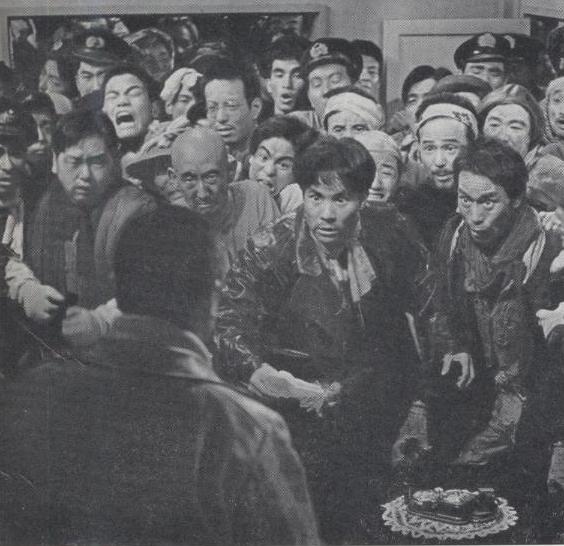
Strike the Hour
These
initiatives were significant achievements in themselves and led to a
new Internet presence as well. It is striking, however, that the
antiwar angle failed to spark a broad interest in Kobayashi Takiji.
What
was required for that to happen was not only a widespread
acknowledgement of economic crisis, but the much more difficult
recognition—for a society habituated to regarding itself as
homogeneously middle-class—that the solutions being adopted were
creating dramatic disparities. The bursting of the bubble economy in
the early 1990s led to an onslaught of structural readjustment. Suicide
rates took a leap beginning in 1998. (The figure of 30,000 per year has
not changed in ten years and places Japan second only to Russia in the
G8.) Signs of economic “recovery” came around 2003 and were heralded in
the media without acknowledgment of the cost, which was growing income
disparity. Prime Minister Koizumi himself provided distractions from
such recognition by playing up his eccentricity as evidence of
independence and by engaging in a hyper display of patriotism in visits
to Yasukuni Shrine, obscuring the real damage he was doing to the
majority of Japanese citizens. Concurrently, a blame-the-victim
approach was prepared through government responses to the three young
hostages in Iraq (2004), captured in the expression jiko sekinin, “personal responsibility.”
Perhaps
the first sign of recognition that the economy, if indeed it was
recovering, was doing so in a way that benefited the few and injured
the many came in the selection of the phrase “income-gap society” as
one of the ten keys expressions of the year 2006. The alarming numbers
of the irregularly employed and the concentration of unemployment among
the young made it apparent that the emphasis on “free” in the
expression “freeters” (furiitaa) was no longer appropriate. If
increasing numbers of the young were to be found in dispatch and other
forms of irregular employment, it was no longer because they preferred
to be unshackled to a regular job, but because they had no choice. The precariously
situated young (yielding the term “purekariaato,” said to derive from
an Italian grafitto combining “precario” and “proletariato”) found
their champion in the erstwhile rightist
punk-rock-band-singer-turned-labor-activist-and-writer Amamiya Karin.
Amamiya, a conspicuous media figure in her “gosu rori” (Gothic Lolita)
fashion.

It
is one of her book titles that has provided a slogan for the
anti-poverty movement: “ikisasero,” or “make us live,” a neologism
insofar as it is a demand and not a plea to “let us live.”

Amamiya was to play a key role in the Cannery Ship revival.
Here,
a brief chronology of the boom might be useful. Two newspaper articles
served as major catalysts. First, a conversation between Amamiya and
established novelist Takahashi GenichirÅ in the nationally circulated
daily Mainichi (January 9, 2008) in which Amamiya observed that reading Cannery Ship,
she was struck by how the conditions depicted mirrored the current
desperate situation of young workers. (Why was Amamiya reading this
work? She was preparing for a discussion on literature and labor to be
published on the pages of Minshu Bungaku (Democratic
Literature), a formally independent journal with close ties to the
Japan Communist Party. Amamiya, in her early 30s, seems to effortlessly
cross the boundaries between old and new left and new new left,
liberal, socialist, and communist publications. (For her presence in
the Save Article 9 movement and other activities, see this website.) Amamiya’s comment was quoted widely and found its way into the second influential article, in the major liberal daily Asahi on February 16. In the course of the article, senior editorial writer Yuri Sachiko referred to an essay contest on Cannery Ship in
which she had been a judge. Cosponsored by the Takiji Library and Otaru
University for Commerce, the contest targeted (a) young readers (age
limit of twenty-five) but also (b) made room for older and
unconventional readers (such as homeless readers, through internet café
submission) and offered substantial prize money for responses to Cannery Ship, or more precisely, the manga
version published in 2006 by the Library. (In fact, the winning
entrants went on to read the novella, as evident from the collection of
submissions, which in turn sold well: Watashitachi wa ikani kani kosen o yonda ka, or How We Read the Cannery Ship).
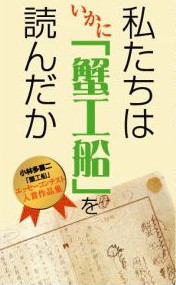
The Asahi
article prompted a bookstore worker in charge of stocking paperbacks to
read the novel. Stunned by how it spoke to her own experience of three
years as a “freeter,” she ordered 150 copies from Shinchosha, the
publishers of a paperback edition, who were frankly bewildered to
receive such an order for a long-forgotten title. Once received, the
copies were stacked with a handwritten pop-up sign suggesting that the
conditions of the “working poor” might constitute a veritable “cannery
ship.” “Working poor” was already familiar as a phrase, and here it was
effectively paired with the unfamiliar, but concretely suggestive
“cannery ship.” Middle-aged male readers, the first to notice, began to
yield to young people in their twenties. Then, on May 2, during the
slow-news period of “Golden Week,” the top circulation conservative
daily Yomiuri made the boom—which did not yet exist–its
topic article of the evening edition. Soon, television stations began
vying with one another to take up the improbable hot topic of the day,
their cameras going to bookstores, and filming essay contest winners.
By the end of May, Shinchosha had reprinted 200,000 copies. By December
2008, it is estimated that 600,000 copies of this edition alone had
made their way to bookstores. Other publishers followed suit; one
(Shukan Kin’yobi) produced a new hard-cover edition with an
introduction by Amamiya in which she meticulously analyzed the
parallels between labor conditions as depicted in the novel and those
of the present-day. There are now four manga versions on the market.


A
documentary on Takiji’s life by Hokkaido Broadcasting Corporation won
the Agency for Cultural Affairs Grand Prize, edging out major
productions by NHK, the National Broadcasting Corporation (Inochi no kioku: Kobayashi Takiji Nijukunen no jinsei; found here,
in Japanese). Not only are more titles forthcoming in 2009, but a stage
production and a feature film scheduled as well. All of this would
surely have been welcome to Takiji, an eager filmgoer, ardent yet
critical fan of Charlie Chaplin, interested in all genres that would
bring the movement to more people.
What can we
make of this concatenation of events? It seems to be a miraculous
meeting of pure contingency and absolute necessity, of commercial
appetite and human need. Without the long investment in Takiji and his
works (collecting, editing, reprinting, issuing newsletters, observing
his death anniversary) on the part of a few groups, many associated
with the Japan Communist Party, the resources would not have been
available for this historic moment. Takiji could have lived on like
this for another decade, until the aging keepers of the flame died out.
To be sure, there were individuals newly interested in him thanks to
the activities of the Takiji Library, but they did not constitute a
group; if they knew each other, it was through the Internet. For Takiji
to survive beyond dusty library shelves, something utterly different
needed to happen. That is, somehow, there had to be a meeting between
his 1929 fiction and the political-social order of the present, a
meeting that could only take place in the hearts and minds of those
compelled to live under the strictures of the latter.
Two
liberal newspaper articles, an initial book order of 150 copies, then a
conservative newspaper article turned the trickle of interest into a
flood. Finding a story that sells is of course a central preoccupation
of the media, with the hoped-for outcome being a cascade of sales. The
aura of newsworthiness prompted publishers to reprint more copies,
bookstores to provide more space, provoking further media attention,
then more copies reprinted.
And in this
largely commercial process, something began to happen. Kitamura
Takashi, in a report at the 2008 Kobayashi Takiji Memorial Symposium at
Oxford in October (see [2], below) observes a shift in the nature of
the reporting, which began with the familiar observation of
similarities but then evolved to registering and reproducing the
novella’s claim that banding together in resistance can lead to social
transformation. In other words, journalists following the story began
to recognize themselves in it and to express their own desires in print
and on the airwaves.
Not That We Are Exploited, but Why and How, and What We Must Do
The
phrase “kani kosen” ended up among the top ten key expressions of 2008.
The phrase, in other words, had become a metaphor that enabled many
people to grasp their condition. It drew together terms such as
“working poor,” “lost generation,” and “income-gap society” into a
coherent whole in its image of inescapable exploitation: a factory
ship, subject neither to international maritime law nor factory
regulation because of its hybrid nature, operating in frigid waters
near the Soviet Union, with workers of diverse origin who were driven
to compete for marginal advantages in literally deadly conditions of
labor. In fact, it was this condition—that workers were confined on
board ship and faced with a visible enemy in the form of slave
overseer-like bosses—that led some to question the applicability of the
novella to present-day conditions, wherein temporary workers are
scattered and the exploitation often abstract and impersonal. Takiji
makes clear in the work, however, (1) that it is a slow, difficult
process for the hierarchically separated, motley group of workers to
reach the understanding that only through solidarity do they have any
chance of survival and (2) that their real enemy is not the brutal
overseer before them, but the structure comprised of bankers in Tokyo,
the imperial military, and global capital. (In fact, the workers’ first
uprising fails because they expect the imperial navy to defend them,
loyal imperial subjects, against their unjust bosses. Having learned
their lesson, they must rise up “again…and again.”) About his next
major work Fuzai jinushi (The Absentee Landlord, 1929),
Takiji wrote his editor that his purpose was not to show tenant farmers
that they were wretched, which they knew all too well, but why and how
they were maintained in that condition, and that the way forward was
struggle through solidarity not only among themselves but with urban
workers as well.
After decades of
depoliticized emphasis on consumer pleasures, accompanied by
atomization masquerading as individualism and fostered by educational
and workplace competition—decades in which the word “labor” was all but
forgotten despite the rising phenomenon of death-from-overwork (karoshi)—it
should, in fact, not surprise us that there was no contemporary
literary work that could provide such an intuitively compelling image
of both exploitation and resistance. Indeed, now that we have been
thrust in a worldwide depression, the image of the “cannery ship” is
more comprehensive than ever, coinciding with that image of “spaceship
earth” from a time when astronauts still provided us heady excitement
and hope.
The aspect of the “cannery ship”
image that continues to be under-recognized is that of the military.
Acutely attuned to the imbrications of the class system, colonialism
and imperialism, Takiji argued for the need to join the class struggle
with anti-imperialist struggle. In his penultimate work of fiction, Toseikatsusha
(The Life of a Party Member), published after his murder in 1933, the
protagonist, together with comrades, is organizing in a factory that
has suddenly been ordered to produce gas masks for use on the
continent. The goal is to persuade regular and temporary workers to
stand together for their rights and to oppose the use of
their labor for an imperialist war. Since permanent workers were
inclined to safeguard their privileges from encroachment by cheaper
temp labor, and temp workers were grateful for a war that was providing
at least short-term wage labor, we can imagine how daunting this
organizing task was.
Daunting, but correct in
terms of principle and analysis. If Japanese activists today, often
securely middle-class, well educated, and middle-aged and older, who
are dedicated to problems of historical consciousness, the former
military comfort women or Article 9,have not seemed engaged by the
antipoverty movement of the young, then the latter have not taken up
the antiwar cause. Given the limitations of time and resources, this is
altogether understandable. But in order to catch up with the
consciousness of Takiji and his comrades of the late 1920s and early
30s, in order, therefore, to be adequate to the demands of the present,
it is necessary to join the antipoverty and antiwar struggles. That
entails overcoming the sectarian residues from the 1960s and 70s as
well as generational divides.
Two new journals give a hint of the discussions and actions that are underway: POSSE, run by an NPO membership in their early twenties and dedicated to labor issues, and Losgene, which bills itself as a “Pan-left Journal.”
The New Bearers of Solidarity and Struggle
The Cannery Ship
boom issued from and feeds a hunger for collectivity and activism amid
the loneliness and cynicism produced by neo-liberal callousness.
Communist Party membership has been increasing at the rate of 1000 per
month over the past year and has attracted mainstream media attention.
New kinds of unions are springing up around the country, welcoming
single members, providing legal advice and support, demonstrating that
collective bargaining is possible even for dispatch workers. From
December 31st to January 5th, twenty some
organizations, including these unions as well as mainstream labor
confederations, came together as part of the Anti-poverty Campaign
(found here, in
Japanese) to establish a “New Year’s Village for Temp Workers”
(“Toshi-koshi haken mura” in Japanese) for those who had been summarily
terminated and rendered homeless just as administrative offices closed
for the new year holidays. Tents went up in the heart of Tokyo in
Hibiya Park, under the nose of the Labor Ministry; food and legal
advice were provided, and most importantly, the New Year was greeted in
the company of others and before the eyes of the nation.


No
doubt Takiji would have rejoiced in these developments, too. Committed
as he was to the cause of poor women—often depicting their skills as
organizers in his fiction–he might have been especially intrigued by
the case of Iwagami Ai, who was unlawfully fired by a shop specializing
in the BABY line of Lolita fashions (her website can be found here, in Japanese).

Photo Credit: Akahata
Clad
in her long black Gothic Lolita dress, surrounded by customers in pink
and white ruffled dresses, Iwagami speaks at May Day rallies and
labor-rights’ study groups. She has won broad support from the new
unions and is taking her case to court: “Workers have the right to
stand in unity, to engage in collective bargaining, and to take
collective action.”

Why Literature?
In Cannery Ship
as well as in other works, Takiji makes frequent reference to the
colonies and to the “semi-colonial” brutality of the police. He
understood the periphery to represent both backwardness and
possibility. Looking to the Scandinavian writers who raised key issues
in modern literature, he acknowledged a similar aspiration for himself,
an “absentee writer,” absent, that is, from the center in Tokyo,
situated as he was in the semi-colonial periphery of Hokkaido. But he
expected truly great “absentee writers” to emerge from the colonies,
from Korea and Taiwan.
No doubt, again, that he would have been gratified to see a new Korean translation of Cannery Ship appear
in 2008. But he would also have been thrilled with the rediscovery of
an earlier translation and the journey of the translator Yi KwÄ«-wðn
and publisher Yi Sang-kyðng to speak at his birthplace in Akita
Prefecture in February of 2008.

Photo Credit: Kitamura Takashi, Akahata
Yi
KwÄ«-wðn recounted how, as he translated the works of Marx or Lenin
from Japanese translations in the course of underground activities in
Pusan, he began to yearn for works of literature. Encountering Takiji’s
works for the first time, and feeling a strong affinity for the
portrayal of state violence (in “March 15, 1928”) and underground
struggle (“The Life of a Party Member”) as well as the narrative of the
Cannery Ship, he translated the three, and his friend published them under the title of The Cannery Ship as soon as the Chun Doo-hwan regime came to an end.
Why
did Yi KwÄ«-wðn feel the need for works of literature? Why, for that
matter, did Takiji and his comrades feel the need to produce literature
during their busy, danger-ridden pursuit of social transformation? And
how important is the fact of its being a work of literature to the
revival of the Cannery Ship? We know that the title has
provided an invaluable metaphor enabling people to grasp their current
condition, but what about the work as a whole?
It
remains to be seen if, and how, in these strange and familiar times,
the experience of novelistic ways of seeing, feeling, and thinking will
serve people seeking to redefine their world: from a collection of
atomized consumers to a collectivity of citizens who, by forging
solidarity around the necessity of work, have once gain begun to dream
of a society dedicated to the flourishing of all.
Notes
[1] Anonymously translated as “The Cannery Ship” in the 1933 collection, The Cannery Ship And Other Japanese Stories from International Publishers and as “The Factory Ship” in Frank Motofuji’s 1973“The Factory Ship” and “The Absentee Landlord” from the University of Washington Press.
[2] The 2009 books, in order of publication, to date:
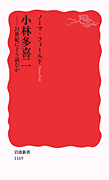
Norma Field, Kobayashi Takiji: 21seiki ni do yomu ka [Reading Kobayashi Takiji for the 21st Century] Iwanami Shinsho.
Ogino Fujio, Takiji no jidai kara miete kuru mono: Chian taisei ni koshite [What the age of Takiji reveals: In protest of the public peace and security regime] Shinnihon Shuppan.
2008 Okkusufodo Kobayashi Takiji kinen shinpojiumu ronbunshu: Takiji no shiten kara mita shintai chiiki kyoiku
[Report of the 2008 Kobayashi Takiji memorial symposium at Oxford:
Body, region, and education] Otaru University of Commerce and
Kinokuniya.
Hamabayashi Masao, “Kani kosen” no shakaishi: Kobayashi Takiji to sono jidai [A social history of Cannery Ship: Kobayashi Takiji and his age] Gakuyu no To mosha.
A trailer of the feature film with Matsuda Ryuhei, to be released this summer, may be seen here.
The Haiyuza Theater, marking its 65th year, will stage a new production of Kani kosen in May.
Norma
Field teaches in the Department of East Asian Languages &
Civilizations at the University of Chicago and is a Japan Focus
associate. She is the author of In the Realm of a Dying Emperor: Japan at Century’s End.
Her most recent book is Kobayashi Takiji: 21seiki ni do yomu ka (Iwanami Shinsho 2009).
This
article was written for Quarterly Changbi (Spring 2009) and is
reprinted in slightly revised form with the addition of notes and
photographs, and with grateful acknowledgement to its editors and
publishers.
Posted at The Asia-Pacific Journal on February 22, 2009.
Recommended citation: Norma Field, “Commercial Appetite and Human Need: The Accidental and Fated Revival of Kobayashi Takiji’s Cannery Ship” The Asia-Pacific Journal Vol. 8-8-09, February 22, 2009
SEE ALSO
Why a Boom in Proletarian Literature in Japan? The Kobayashi Takiji Memorial and The Factory Ship
「蟹工船」日本丸から、21世紀の小林多喜二への手紙。

Leave a Reply
You must be logged in to post a comment.